Green Card Caps: Why Your Birth Country Sets Your Wait
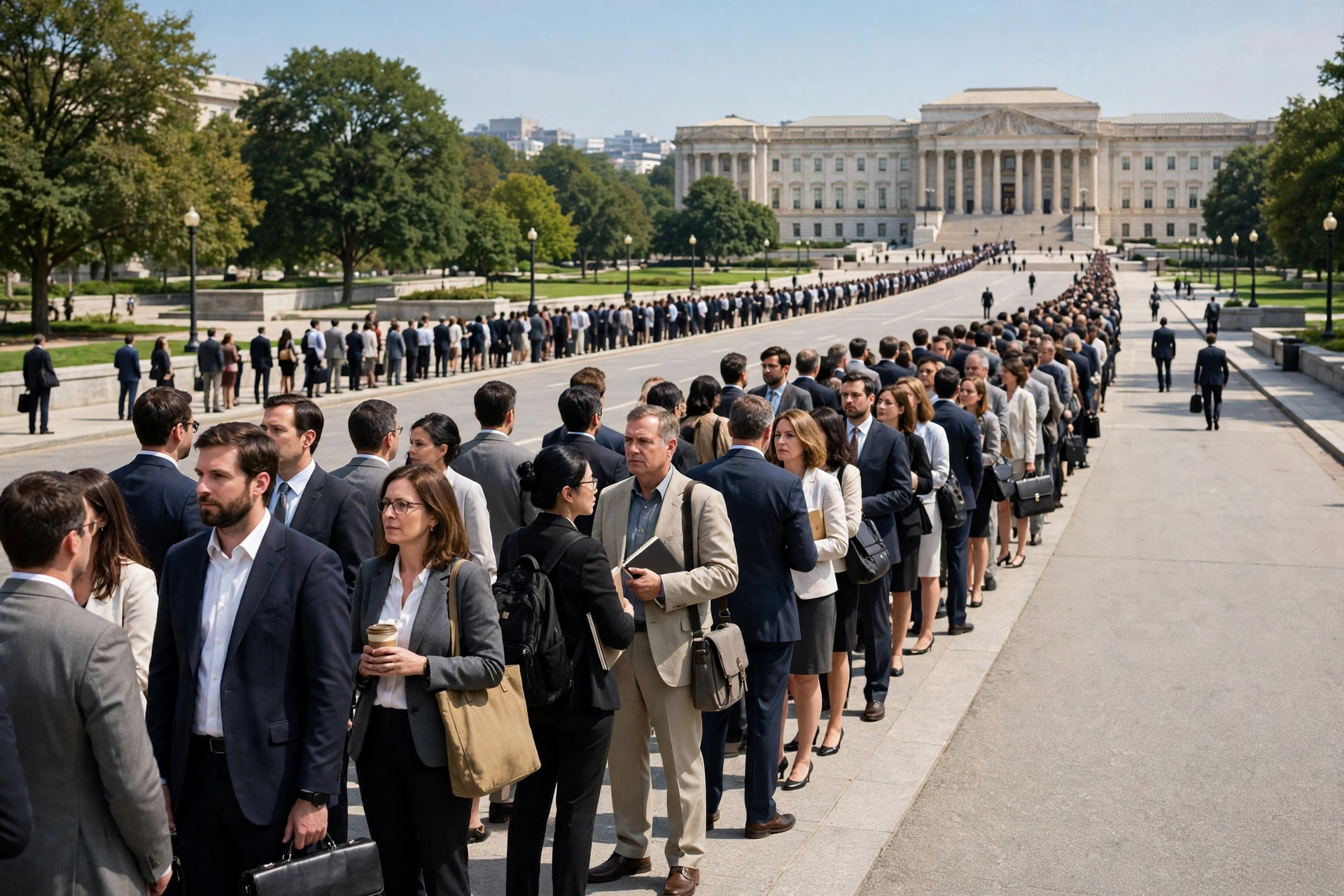
Two people can do the same job, work for the same kind of employer, have approved immigrant petitions, and hold priority dates only weeks apart — and one gets a green card while the other waits for decades. The difference is usually not merit, and it is not the employer. It is the country each of them was born in.
Here is the rule that produces that result. Employment-based immigration has a worldwide floor of at least 140,000 immigrant visas a year, and that number includes spouses and children, not just workers. On top of that, the per-country limit in the Immigration and Nationality Act says that people chargeable to any one country may receive no more than 7% of the combined family-sponsored and employment-based preference visas in a year. Chargeability follows your country of birth, not your citizenship and not where you live now.
Run the arithmetic and the backlogs explain themselves. Demand from India and from mainland China is many times larger than one country's share, year after year, while demand from most other countries fits inside theirs. Everyone joins the same preference categories — EB-1, EB-2, EB-3 and the rest — but an applicant born in India or China can only move when that country's slice has room. Mexico and the Philippines are oversubscribed as well. Unused numbers do move: numbers one category does not need fall down to the next, and numbers that would otherwise go unused can be issued in priority-date order without regard to the per-country limit. That spillover helps at the margins. It has never come close to clearing a line this long.
The Fairness for High-Skilled Immigrants Act was the bill written to end this. Its core was simple: strike the per-country limit for employment-based visas entirely, raise the per-country limit for family-sponsored visas from 7% to 15%, add no new visas at all, and hand out the existing employment-based numbers strictly in priority-date order — first come, first served, regardless of birthplace. To soften the change, the House version reserved a share of EB-2, EB-3 and EB-5 visas during a short transition for applicants from countries other than the two with the largest backlogs, and capped any single country at 85% of the unreserved visas in those transition years.
Be clear about the trade-off the bill always carried, because it explains most of the politics. With no new numbers, ending the cap does not shorten the total wait — it redistributes it. The India and China lines would have moved far faster, and applicants from everywhere else, who had been getting green cards quickly, would have waited longer, in one common line. Supporters called that fairness: one queue, ordered by filing date. Opponents called it a different unfairness: one or two countries taking most of the numbers for years while everyone else's wait grew. Both descriptions are accurate. That is why the bill was hard.
And it has not happened. The House passed its version, H.R.1044, by 365 to 65. In the Senate, the companion bill, S.386, spent a long time blocked — a single senator can stop the unanimous-consent route these bills rely on, and several did, over nurses, over H-1B rules, and over the redistribution itself. The Senate eventually passed the House bill with a substitute that added H-1B employer requirements, limits tied to H-1B and H-4 status, and other provisions the House had never approved. Two different bills with the same name are not a law. The versions were never reconciled, nothing was sent to the President, and the measure expired with that Congress. Its successor, the EAGLE Act, was reported out of committee and reached the House floor, where proceedings were postponed and never completed. No version of this idea has become law. The 7% per-country limit is still the law today, and anyone who tells you the caps have been lifted is wrong.
So what do people actually do while the line barely moves? First, know your priority date and watch the Visa Bulletin properly. The bulletin carries two charts: Final Action Dates, when a green card can actually be approved, and Dates for Filing, when an adjustment application may be filed if USCIS allows that chart that month. Filing early matters even when approval is years away, because a pending adjustment application can bring work and travel permission and a measure of stability while you wait.
Second, check cross-chargeability before assuming you are stuck in the longest line. Chargeability normally follows your own country of birth, but the statute lets a principal applicant be charged to a spouse's country of birth instead when the spouses were born in different countries and are immigrating together. An India-born applicant whose spouse was born in a country with a short line may be able to use that line. It is one of the few genuine shortcuts in this system, and it is missed constantly because nobody asked where the spouse was born.
Third, protect the place in line you already have. Once an I-140 is approved, its priority date is generally yours to carry into a later employment-based petition — that retention is lost only on narrow grounds such as revocation for fraud or misrepresentation, a revoked labor certification, or material error in the approval. An approved petition can also support H-1B extensions beyond the usual six years while you wait. And once an adjustment application has been pending for 180 days or more, the portability rule lets you move to a new job in the same or a similar occupation without starting the green card case over. These rules are what make a decades-long wait survivable: your date, and eventually your case, can move with you.
Fourth, look honestly at whether a higher category is real for you. An earlier priority date carries into EB-1 and into an EB-2 national interest waiver petition, and those lines are shorter than the EB-2 and EB-3 lines for India and China. Shorter is not short — EB-1 has its own cut-off dates for India and China, and it is not a refuge from the backlog, just a better position in a related one. The investor category also has small reserved pools for rural, high-unemployment and infrastructure projects, which have their own queues and their own risks. None of this is a reason to file a weak petition. It is a reason to test, early, whether the stronger category is genuinely there.
None of these steps repeals the 7% limit. Only Congress can do that, and so far Congress has not. What the steps do is keep an approved case alive, portable and ready — so that when your date is reached, by movement in the bulletin, by cross-chargeability, or one day by legislation, there is nothing standing between you and the green card except the wait itself.
Tell me what you are working on and I will reply in writing, focusing on the issues involved.
General information, not legal advice. Requirements and processing change; we confirm current rules for your case.