H-1B Specialty Occupation: The Degree Isn't the Job
I get this question more than almost any other in H-1B work: what makes a job a specialty occupation? It is not the job title, and it is not whether the person holding the job is smart or well qualified. It is whether the position itself, as the employer actually defines it, requires a specific body of specialized knowledge — and, in practice, a bachelor's degree or higher in a specific field, or its equivalent, as the minimum to do that job.
That distinction matters, because USCIS looks at the job first and the person second. A brilliant engineer in a job that any capable graduate could fill is not a specialty occupation case. A well-defined engineering job that genuinely requires that training is, even if the title sounds ordinary.
So how does USCIS test it? In plain terms, the employer has to show one of several things: that a degree in a specific field is normally the minimum for the job, that the degree requirement is common in the industry for similar jobs, that the employer normally requires it, or that the job is so complex or unique that only someone with that specialized knowledge can do it.
Notice what is not on that list: a wish, a preference, or a habit of hiring people with degrees. "We like to hire graduates" is not the same as "this job requires a graduate." The job description, the duties, and the employer's actual hiring history have to line up.
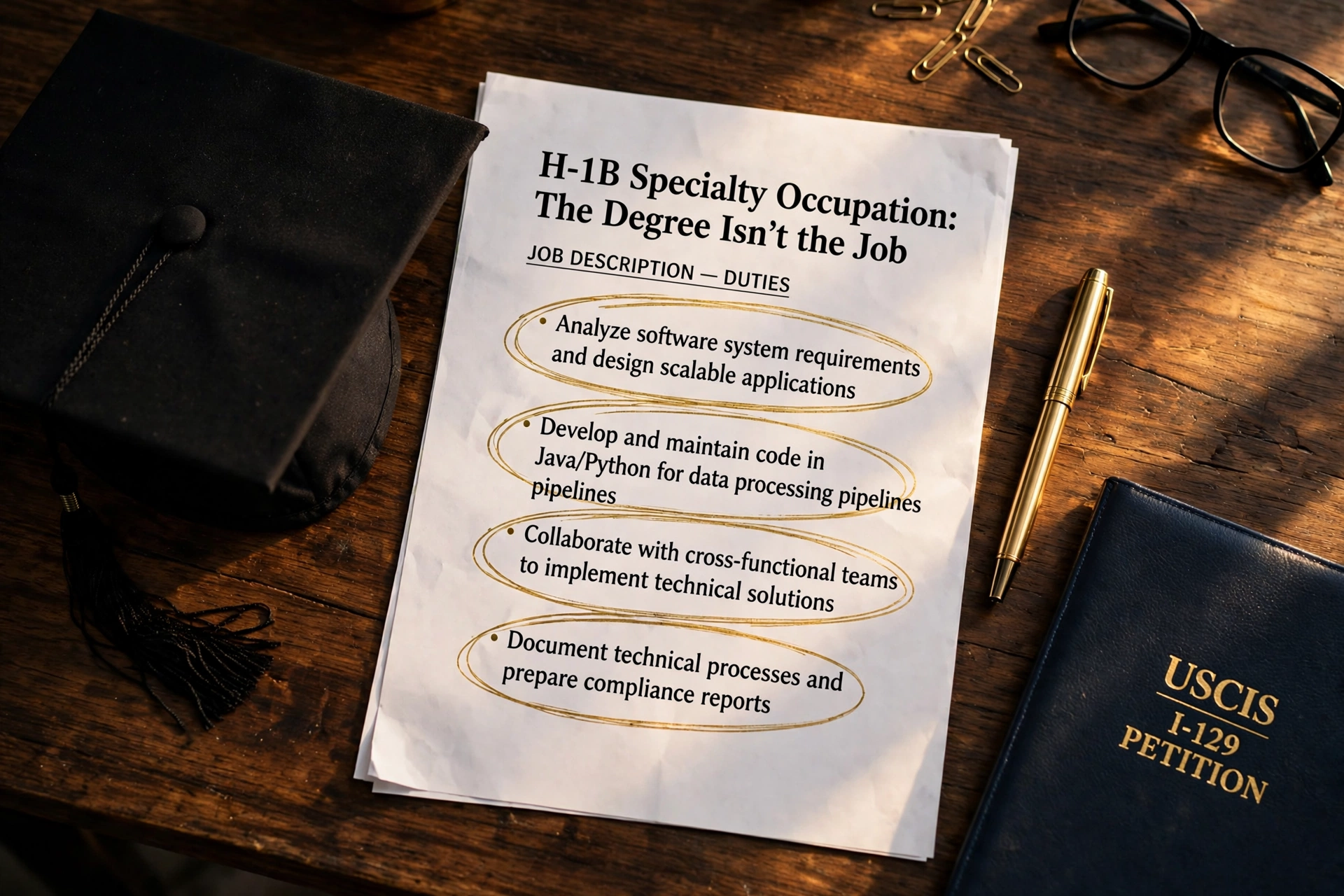
The duties are where most cases are won or lost. A list of vague tasks — "will work on projects, will help the team, will use technical skills" — tells USCIS nothing. Specific duties do: what systems, what tools, what decisions, what level of judgment, and why that work cannot be done without the specialized training. If the duties read like a generalist job, USCIS will treat it like one.
The degree field matters too. The degree has to be directly related to the job, not just any degree. A computer science degree for a software engineering job fits. A general business degree for a highly technical engineering job, with no explanation, does not. Where experience substitutes for a degree, that equivalence has to be documented carefully — it is not a shortcut, and it is not assumed.
Registration and selection are a separate step, and they come first for cap-subject cases. Selection is no longer a straight lottery: under the wage-level-weighted selection rule, a registration is entered in the selection pool once for a Level I wage, twice for Level II, three times for Level III, and four times for Level IV. A higher wage improves the odds; it does not guarantee selection. Being selected does not mean the specialty occupation question is settled. That question is decided when the petition itself is filed and adjudicated, on the evidence about the job.
If you are an employer, the practical advice is simple: define the job honestly, write the duties the way the job actually works, and require only what the job truly requires — but require all of it, and be ready to prove it. If you are a beneficiary, ask to see the job description before the petition is filed. You should know what USCIS will be asked to believe about your job, because that description is the case.
Tell me what you are working on and I will reply in writing, focusing on the issues involved.
General information, not legal advice. Requirements and processing change; we confirm current rules for your case.